


Try it
Every level is a prefix of the same compressed file. Going up decodes the next chunks and adds their primitives; going down draws fewer of them. There is no second model to load. Drag the slider, or watch it move by itself.










Bicycle, 3DGS-MCMC backbone: the paper's results for this scene (PSNR on the test views, FPS on an NVIDIA A40 GPU). Decoding all eight levels takes about 0.9 s.
In short
Most codecs for splat-based radiance fields are single-rate: one optimized model per bitrate. GoDe gives the whole rate–distortion curve from one model.
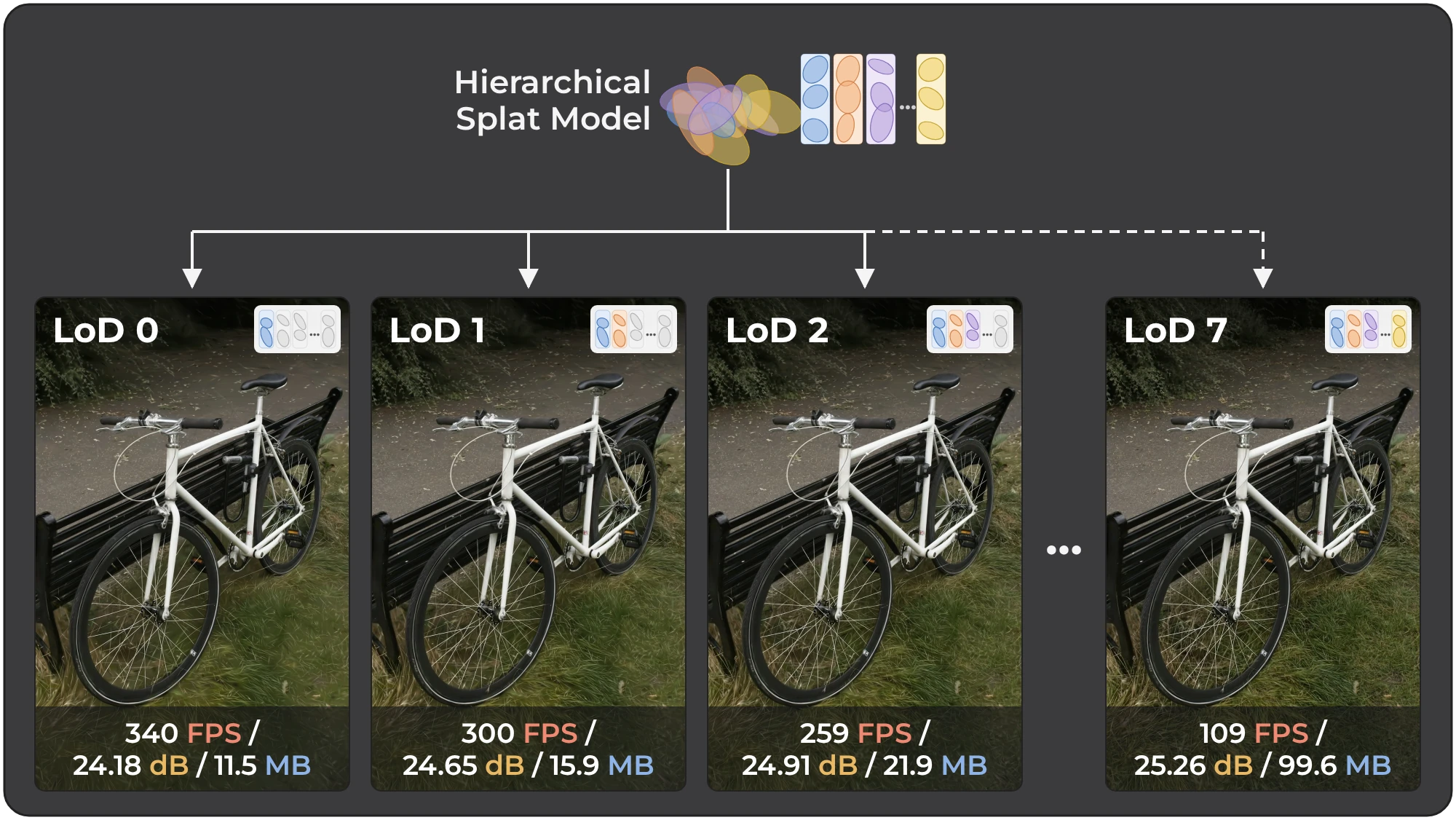
from one model (up to 32 in the ablations); each level is a prefix of the same compressed file.
Gaussians, triangles, neural anchors, octrees, Spherical Voronoi colour. The backbone is not modified.
to decode, one to two orders of magnitude faster than existing codecs (9–88 s single-rate, 42–52 s for PCGS).
Abstract
Splat-based radiance fields have rapidly diversified in primitive type, kernel support, and appearance parameterization. This diversity makes compression difficult: most codecs are single-rate, requiring a separately optimized model for each target bitrate, while progressive codecs remain tied to representation-specific assumptions that do not transfer across backbones. We introduce GoDe (Gaussians on Demand), a progressive compression framework whose central contribution is backbone agnosticism: it reorganizes any trained differentiable splat representation into a single scalable bitstream without modifying the backbone or re-deriving the compression structure for each new primitive type. GoDe builds a nested level-of-detail hierarchy via masked-gradient importance ranking, refines all levels with one quantization-aware fine-tuning stage, and stores the base layer and enhancement layers as progressive chunks compressed with shared entropy dictionaries. Any decoded prefix is directly renderable, so one training pipeline provides multiple rate–distortion operating points without per-rate retraining. Across five heterogeneous backbones and three standard benchmarks, GoDe achieves competitive rate–distortion performance while enabling faster rendering and substantially faster progressive decoding than existing methods.
Method
Three stages, applied to an already trained model. They need only a differentiable renderer and a serializable parameterization.
Swipe sideways to see all three stages.
1Hierarchy
Primitives are ranked by their gradient norms, each parameter group normalized, and the least important are masked out level by level, recomputing gradients after every step. Coarser levels are strict subsets of finer ones. Building eight levels takes 1–2 minutes.
2One fine-tuning
All levels share one set of parameters. Each iteration samples a level and a view and renders that level with simulated quantization (float16 geometry, int8 appearance), so the cost does not grow with the number of levels.
3Progressive coding
The base layer and each enhancement layer are compressed as independent chunks with shared Zstandard dictionaries. Decoding a level is decoding and concatenating its chunks; an opacity ramp makes switching smooth.
Levels of detail
Move the slider (or use the arrow keys) to go through the eight decoded prefixes of one model. The renders here and in the videos below use Beta Splatting with Spherical Voronoi colour as the backbone.
Switching levels
Each video goes through the levels of one model, Beta Splatting with Spherical Voronoi colour. Enhancement layers fade in through an opacity ramp applied at render time; the stored bitstream is unchanged.
Results
Each coloured curve is one GoDe model, decoded at all eight of its levels. Grey points are single-rate codecs, each trained separately for its rate; PCGS is progressive, but specific to the Scaffold-GS family. Hover a point for its values.
Dataset averages; FPS on the test views at the datasets' resolution, NVIDIA A40. GoDe levels: supplementary Table S7; other methods: Table 2 (FPS not available for Codec-GS and HEMGS).
Training and decoding time
Non-scalable codecs train once per rate; GoDe trains once for all of them. Decoding is cumulative over the levels needed for each rate.
Training in hours, coding in seconds (Table 3). Low, Medium and High are the three operating points of Table 2. PCGS uses one shared encoding for all its rates.
One pipeline, five backbones
GoDe treats primitives as atomic units: it never looks inside them. The same procedure runs on representations that differ in primitive type, kernel, and appearance model.
BibTeX
@article{disario2026gode,
title = {GoDe: Gaussians on Demand for Backbone-Agnostic Progressive Compression},
author = {Di Sario, Francesco and Renzulli, Riccardo and Grangetto, Marco and
Sugimoto, Akihiro and Tartaglione, Enzo},
journal = {arXiv preprint arXiv:2501.13558},
year = {2026}
}